Người đăng: vanmai yeu em on Thứ Sáu, 8 tháng 12, 2006


Number 65


Frankenstein Friday: The Lorelei


After last story's meeting with the legendary Flying Dutchman, Frankenstein meets up with the equally legendary siren, the Lorelei.

It's a short five-page story, which features the Lorelei as a blonde babe. There's even a panel of Frankenstein without a shirt; maybe the only beefcake shot of Frankenstein in the whole series.

This story is the fourth story from Frankenstein #7, May-June, 1947, written and drawn by Dick Briefer.


More about

The Silver Surfer and Galactus

Người đăng: vanmai yeu em on Thứ Năm, 7 tháng 12, 2006

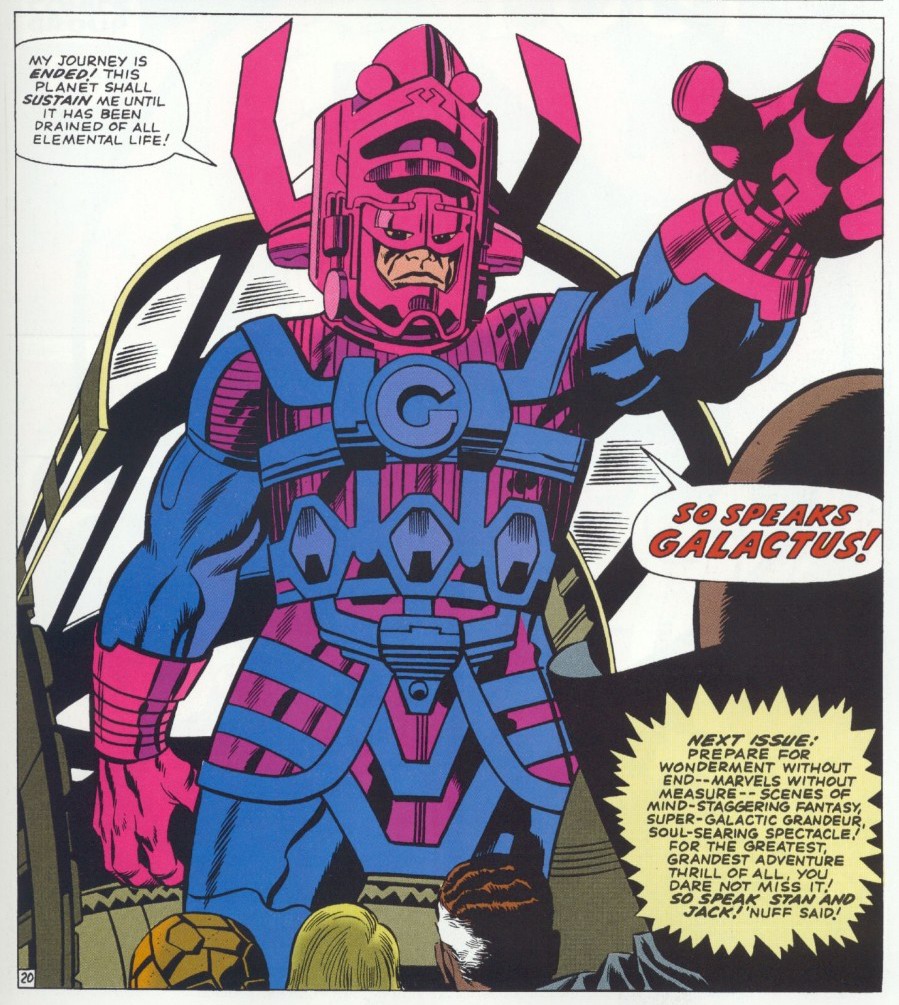
As we have discussed, the Inhumans saga ended (temporarily) about six pages into Fantastic Four #48. But that issue was also significant for the first appearances of the Silver Surfer and Galactus.

The inspiration for the former is pretty obvious. This was the mid-1960s and there was nothing cooler among teens than surfing. Believe it or not, I actually got up on a board a couple times while visiting my cousins on the Jersey shore; the main impression I got was how fast you went; it was definitely a thrill ride.

As the FF returns from the Hidden Land after their encounter with the Inhumans, they discover that New York is covered with a fiery sky. What is going on? We also see the Silver Surfer for the first time, looking through the universe for a particular type of star and a particular type of planet orbiting that star.

It turns out that the Watcher had tried the fire as a way to conceal Earth, but since that caused panic among the humans, he revised his plan and tried hiding us behind a wall of space debris. But the Silver Surfer makes it through anyway and conveniently (for story purposes) lands on the Baxter Building. He sends a signal to his master, Galactus, who arrives with bad news:
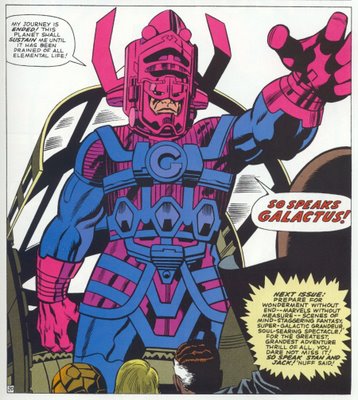


The Thing has punched the Silver Surfer away from the Baxter Building, but in the grandest tradition of coincidence, he lands atop Alicia Master's skylight. She treats him with kindness, and is horrified when the Surfer tells her of Galactus' intentions for Earth. We can see that he is swayed by her arguments.

Meanwhile, the Thing and Mr Fantastic have temporarily delayed Galactus' plan to drain the earth of its energy. The Watcher sends Johnny to the home world of Galactus, where a weapon exists that may stop him. And Alicia convinces the Silver Surfer to attack his master in an effort to save Earth.

In Fantastic Four #50, we see the battle between the Silver Surfer and Galactus. While the latter is clearly more powerful, the Surfer is not without some ability himself. Meanwhile Johnny is racing back with the weapon from Galactus' homeworld. He arrives in the nick of time and hands off the instrument to Reed. Threatened with potential destruction, Galactus agrees to leave. But first he strips his former herald of the ability to roam among the stars; he will be stuck on Earth.

These are terrific issues; at this point the FF was going from strength to strength, with Stan and Jack turning out memorable characters seemingly at will, from the Inhumans to the Silver Surfer and Galactus to the Black Panther, who would shortly make his initial appearance.
More about

Người đăng: vanmai yeu em


Number 64


COVERING UP: Classic covers of Golden Age Comics: Remember Pearl Harbor


Today is the 65th anniversary of the bombing of Pearl Harbor, the event which propelled Americans into WWII. The nature of the attack was such that it caused an instant reaction in the public. Outrage.

All media, and all popular media, immediately responded. Comic books were no exception.
Here are some examples of comics published right on the heels of Pearl Harbor. The first, Remember Pearl Harbor, drawn by Jack Binder for Street and Smith Publications, is a patriotic cover: Uncle Sam rolls up his shirt sleeves and strides across the Pacific to kick some butt!

Comics, by virtue of their cartoony origins, used their ability to caricature to present the enemy as inhuman, vampire-toothed, claw-fingered. It wasn't enough to just use the common stereotype of the day, buck teeth and thick glasses, to represent the Japanese. To reflect American anger, they had to be demonized.

The next two, Captain America #14, May 1942, drawn by Al Avison, and Young Allies #3, Spring 1942, drawn by Al Gabrielle, fall into the demon enemy category. On the Young Allies cover Gabrielle draws both types of caricatures: the demon, drooling and sharp-toothed, and the buck-toothed, thick glasses stereotype. Timely Comics used this sort of cover with great success and other publishers soon followed suit.
As a bonus, here's the original art to a cover by Alex Schomburg. Of all of the artists who did comic book covers during the war years, Schomburg really stands out for his excellent drawing ability and his ability to draw fantastic scenarios, with American heroes beating up on Axis gangsters in fantasy settings. This particular cover shows Schomburg's signature type of situation. It's also funny that Schomburg used to label in English the science fiction-styled weapons the enemy is shown using. Other artists copied his formula, but there was only one Schomburg.


Click on pictures for full size images.

More about

Người đăng: vanmai yeu em on Thứ Ba, 5 tháng 12, 2006


Number 63


The Face


We'll soon be observing the 65th anniversary of the attack on Pearl Harbor, the event that drew America into World War II. While mobilization was taking effect, the comics jumped right in, sending their characters into the fray, usually whipping on the enemy with savage ferocity, and of course, coming out the winners.

In real life it wasn't so easy, but the job was eventually done.


The Face was one of those characters. Tony Trent, war correspondent, put on a Halloween mask, his entire costume. Later on in The Face's run in Big Shot Comics, as the strip was re-titled simply "Tony Trent." 


The art was by Mart Bailey, who had a good illustrative style with solid and clean inking. His art style wasn't spectacular, but Bailey was a pro who started his career at DC Comics for Big Shot Comics editor, Vin Sullivan. In a lot of ways Bailey's style reminds me of fellow Big Shot artist, Ogden Whitney, who drew Skyman.

This story, from Big Shot Comics #37, August 1943, shows The Face participating in a Marine invasion of an island, which is in fact what was happening in real life at the same time. The story takes off into a flight of fancy. In real life islands like Iwo Jima and Guadalcanal were taken only after fierce fighting and great loss of lives. The Face and his friends, the bearded "Mattress" McCarthy, spouting his annoying rhymes, and "Babbling" Brooks, showing timidity in the face of the enemy (something you didn't usually see in comics), took care of the situation in short order and the island was taken. Hooray for our side. To his credit, Bailey didn't draw the Japanese as ugly caricatures, which was common in those days. It wouldn't have fit into his style of art at all.


More about

Người đăng: vanmai yeu em on Chủ Nhật, 3 tháng 12, 2006


Number 62


Par Holman's Happy Holidaze


This is the second of five Pappy's Golden Age Sundays featuring Christmas strips, leading up to Christmas Eve.

This is different than my usual Golden Age stories. It's a totally obscure Christmas story that hardly anyone has ever seen. Happy Holidaze was a photocopied comic, done in a 5 ½" x 8 ½" format, and published in 1984.The artist, Par Holman, was one of a group of mini-comix artists working with underground comix historian, Clay Geerdes. He published the newsletter Comix World, later Comix Wave. Geerdes also published hundreds of mini-comix, helping young cartoonists see their work in print.

Holman said of Happy Holidaze: "I did a homemade Christmas card every year, sending them out to my friends. Happy Holidaze was my most ambitious Christmas project, done in 1984. It took a couple of weeks to write and draw. For all that work I only printed up about 50 copies on green paper, and 10 copies on white.

"I saw a copy of Happy Holidaze on an Internet auction site. The seller wanted $16.99 for it. That made my day."
Click on pictures for larger images.

Contents are ©1984, 2006 Par Holman


More about

Our Apocalyptic Past

Người đăng: vanmai yeu em on Thứ Bảy, 2 tháng 12, 2006

One of the hazards of comic books is that a writer may pen a story when the future seems far off and then time passes and suddenly that future is 20 years in the past. So it is with the Atomic Knights. They were formed in the dark days of 1986 after the nuclear holocaust that, as you may recall, didn't quite happen.

However, this was a terrific series nonetheless. In Strange Adventures #117 (June 1960), we learn that Gardner Grayle is a soldier in an underground bunker when World War III starts, with atomic bombs destroying much of the planet. He teams up with Douglas Herald, a schoolteacher, who's hoping to defeat a local tyrant called the Black Baron. By chance, they discover that a set of medieval suits of armor blocks the radiation from the Baron's rayguns, with which he has been keeping control of the local citizenry.

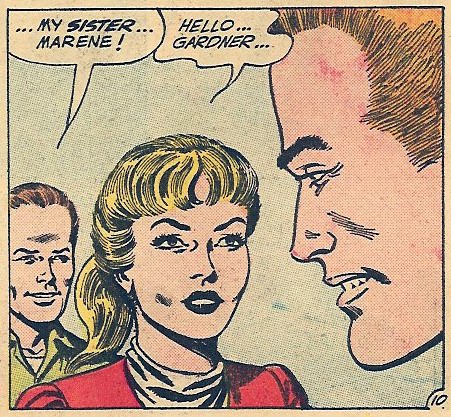
They look for volunteers to help them fill the six suits. Hollis and Wayne Hobard, athletic twins, join up, as does Bryndon, a scientist. However, the final suit proves too small for a grown man, so they leave that one behind. Herald also introduces someone else:


Of course, Marene and Gardner become an item, and following their deepening romance is one of the real charms of this series. In the origin story, the Knights attack the Baron's stronghold, but it turns out that in addition to the rayguns he's got an old rifle. Gardner is unsure that his armor will hold up to a bullet, but at the last moment he is saved by one of the other knights, who pushes the Baron aside, causing him to shoot wide. Gardner later discovers that his savior had been none other than Marene, who had managed to fit into the remaining suit.

The story continued every third issue of Strange Adventures over the next several years. Each was written by John Broome with superb artwork by Murphy Anderson. The stories tended to move forward sequentially; for example, in one story the Knights were attacked by Giant Dogs, but after taming them that issue in later ones the dogs were helpful.

The stories also featured the Knights traveling to different locations in what remains of the the US, with titles like "The Cavemen of New York" and "The Lost City of Los Angeles" and "Danger in Detroit". The series continued like clockwork until Strange Adventures #160 (Jan 1964), when the final instalment appeared. There was no announcement at the time that the series had ended. I suspect that what happened was that Murphy Anderson had been assigned to replace Joe Kubert on Hawkman effective with Mystery in Space #87 (Nov 1963), and that Atomic Knights just didn't fit into his workload any longer (remember that Anderson was one of DC's top inkers in addition to his fine pencils).
More about

Người đăng: vanmai yeu em on Thứ Sáu, 1 tháng 12, 2006


Number 61


Frankenstein Friday: The Curse Of The Flying Dutchman


Frankenstein continues his lonely hearts business and matches up the legendary Flying Dutchman with a woman who is less than a perfect match.

I was disappointed by the rushed art in this story; in the panel I've reproduced above you can see that Frankenstein's eyes aren't even drawn close to the same size. It shows some lack of care on the part of the artist, Dick Briefer, who drew it for Frankenstein #7, May-June, 1947, but it also shows there may have been very little editorial supervision of Briefer. Maybe this comic sold really well, no matter how fast Briefer drew it.

What shows through is Dick Briefer's sense of humor, and while the artwork is speedily done, the panels are well composed. Being the Dick Briefer fan that I am, when that's all I can say about a story then it's gotta be lacking, but for all that I think this little five-pager has some charm. This story is one of two five-pagers from the issue. The second you'll see next Friday.


More about