Number 1179: Kinkdom Come

Người đăng: vanmai yeu em on Thứ Sáu, 22 tháng 6, 2012

Like Wednesday's post about artist Adolphe Barreaux, Gene Bilbrew, who often signed his name "Eneg," published his art in a shadowy realm of disrespectability. His work appeared on covers and interiors of publications catering to a fetish audience. This story, called "The Passion Pit," has no nudity or hardcore sex, just some sexy costuming and a lot of innuendo. It appears Eneg swiped some of his war panels from war comics of the era (1950s), and lavished most of his effort on what the reader paid for, sexy women.

I showed this story in the early days of this blog, but linked the pages to the online storage site, Photobucket. Some of the links have broken, and rather than go back in and fix them I've enlarged the scans and am re-presenting them. As I said in that earlier blog, in the early '60s I was with a friend who bought "The Passion Pit" from a bookseller in a classic under-the-counter scenario."The Passion Pit" was hot in that era, the stuff of Times Square sleaze and the bondage-discipline crowd. Looking at it now makes me wonder how there could have been a time when anyone thought it was pornographic or dangerous. In today's porn-saturated world it seems almost innocent.

Bilbrew was African-American. He died young, about 50. I've seen a couple of sources use different years for his death, 1971 or 1974. What draws us to his artwork isn't technical excellence but an idea of a sexual underground where women dress up in latex and leather, spiky-heeled boots (with spurs, yet!) and dominate men. The "vitalizer" the sisters Fettisha and Sexsina give to the hero, Dick Strong (ho-ho), is a kind of liquid Viagra. The ability to perform sexually with chemical enhancement was a fantasy when this was written and drawn.

In the '70s I found a pirate edition of "The Passion Pit" re-titled "Chinese Torture," which removed Eneg's name. I sold my copy of "Chinese Torture" on eBay years ago, but before I did I photocopied it. The scans are from those copies.


More about

Number 1178: A roscoe sneezed

Người đăng: vanmai yeu em on Thứ Tư, 20 tháng 6, 2012


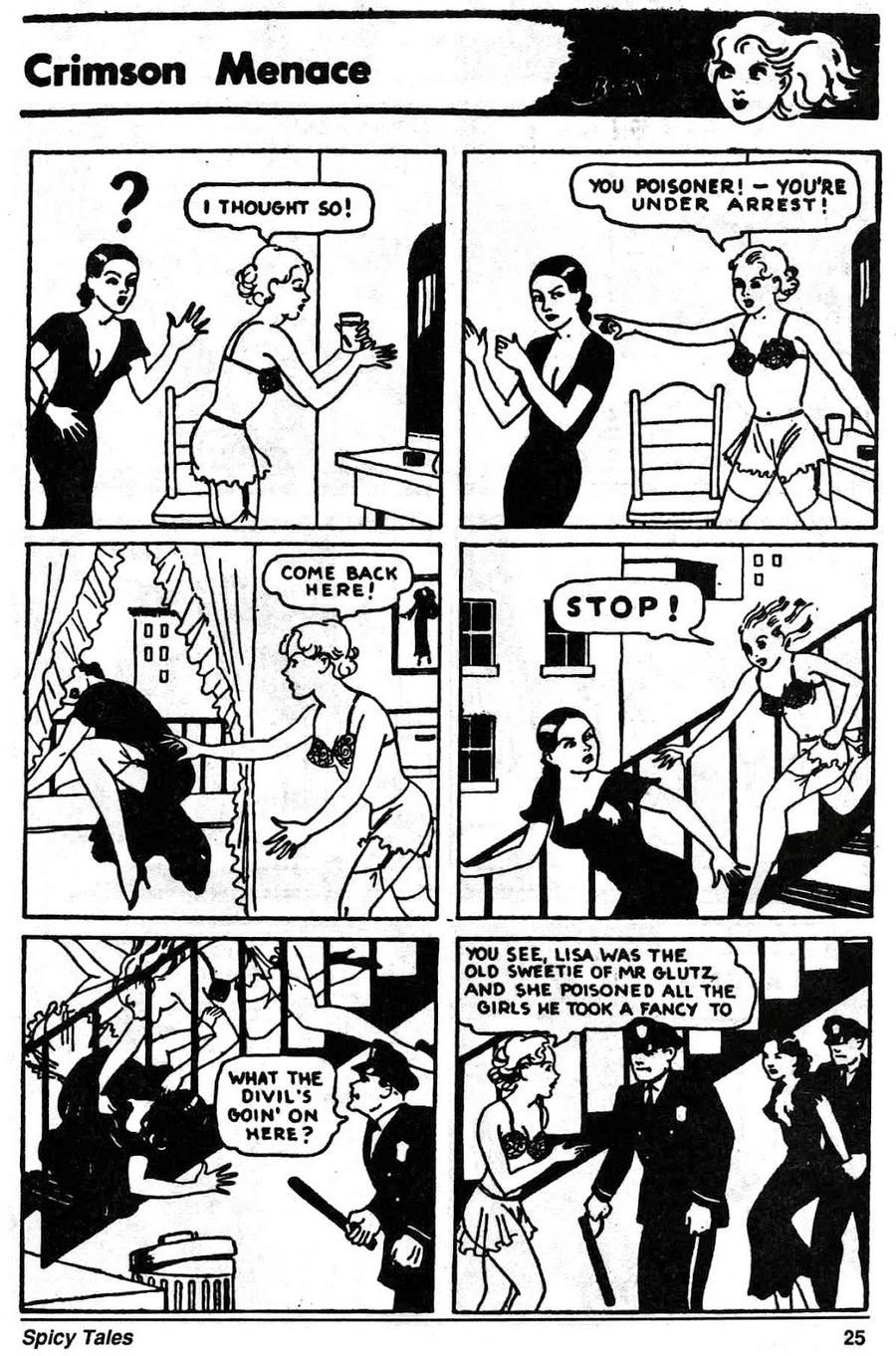
Adolphe Barreaux is a pioneer in the history of comic books. He started out drawing comic book-like stories for Harry Donenfield (who later went on to take over DC Comics from its founder, Major Malcolm Wheeler-Nicholson). Barreaux drew the sexy Sally the Sleuth stories for Spicy Mystery Stories, an under-the-counter pulp Donenfield published before he took over DC Comics. Donenfield set Barreaux up with an art shop, with himself as co-owner, to provide artwork for his line of pulps. Here's an example of Sally the Sleuth, from its days as a two-page strip (and I mean that literally...Sally could not keep her clothes on), from Spicy Detective (March, 1935). The scans are from the 1988 Malibu Comics reprint.


Later Barreaux became editor of Trojan Magazines, Crime Smashers, and other titles, a small publisher also bankrolled from the DC empire. The story of DC's secondary business interests is a complicated one of silent partners, publishing names and different addresses, but it all goes back to Harry Donenfield. He was a sharp businessman who had his hand in the comics business, publishing and distributing, in a big way.

Barreaux is credited with drawing these Dan Turner, Hollywood Detective stories. The color story is from Crime Smashers #7 (1951), and the second is originally from the pulp Spicy Detective (January, 1943), by way of the Malibu Comics reprint, Spicy Tales #1 (1988). Robert Leslie Bellem is credited as the writer. He created Dan Turner for the pulps, and was known for his overcooked dialogue like "a roscoe sneezed," and "Jeepers! Baldy's been skewered through the ticker! He's defunct!" Bellem went into writing for television after the pulps were skewered through the ticker. He did scripts for The Lone Ranger, Adventures of Superman, 77 Sunset Strip, and many more. He died in 1968.

In looking at the artwork for these Dan Turner stories I'm venturing the opinion that despite Barreaux's credit they are shop jobs. Maybe he had something to do with them, and maybe not. In "Off-stage Kill" Dan Turner is shown mostly from the back in a very static layout. The only time the story comes alive is when the girls are fighting. "The Murdered Mummy" has some of the same faults, but is much livelier in its layouts.


More about

Number 1177: The atomic nightmare

Người đăng: vanmai yeu em on Thứ Hai, 18 tháng 6, 2012

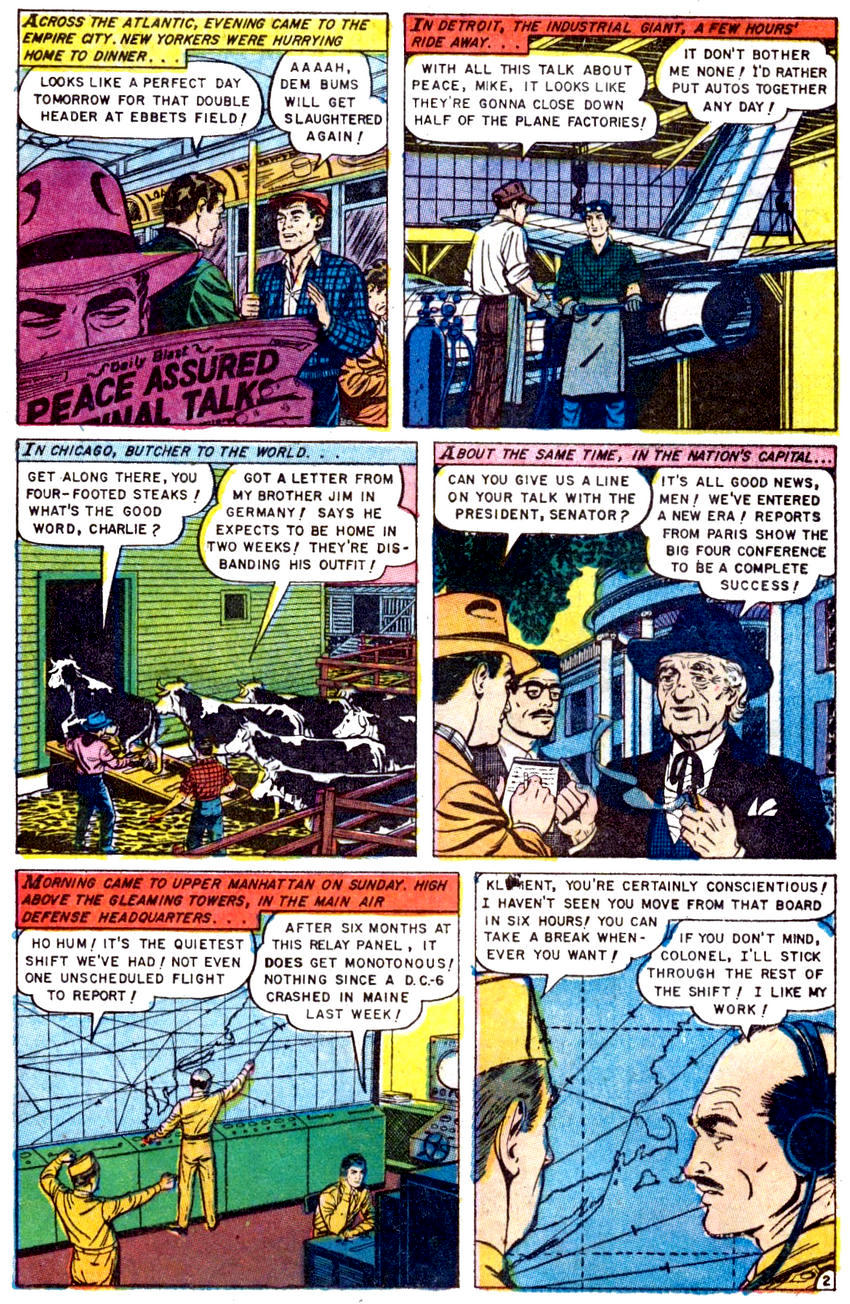
Atomic War #1 (1952), a paranoid classic from Ace Comics, is the stuff of my childhood nightmares. I dreamed about being in an atomic blast. Maybe more of my generation, and our parents' and grandparents' generation, did also. We were very propagandized in the 1950s. I remember hearing the words from a teacher in my elementary school that shocked me: "It's not IF, kids, it's WHEN," in a classroom discussion on how to avoid death when the Big One was dropped on us.

Now we know it was all part of the big lie told to us naïve children, trusting that our adults would know how to protect us. By that time the destruction of cities Hiroshima and Nagasaki had shown if you were in a certain radius there was nothing left of you but vapor, and even outside that radius your days left on Earth were few. An article tells the grim story.


But even in those days of of feeling an attack was inevitable, we knew for it to happen the Russians had to fly in and drop those bombs on us without themselves being shot down by the U.S. Air Force. It was a sliver of hope! Our brave airmen would protect us! Yay!

Artwork is credited by the Grand Comics Database to Ken Rice. Without further ado, my childhood atomic nightmare:


**********

The king's kollection

Two pages excerpted from a longer article.

When King Farouk of Egypt was deposed in 1952 and went into exile much was made of his collections, unearthed during searches of his palaces. Life magazine ran an article, lavishly illustrated in color, in its November 24, 1952 issue, showing some of what was found. To the general public in 1952 comic books and pulps, found in a closet, would have been evidence (along with a massive porn collection) of a lowbrow addiction to sleaze.

What a difference sixty years makes. When I look at the picture of some of Farouk's collection, everything I see (except for the bronze likeness of Farouk himself) I'd want. Even the nudie-cutie paintings look campy and collectible. Does any of it still exist? I don't know.

My guess is for illustration purposes photographer David Douglas Duncan chose items from the closet that would have made the ex-king look foolish. As we see in the photo, besides pin-up magazines, Farouk read Timely publications' funny animal kiddie comics and Millie the Model. He most likely had other comic books, too. The article says he had "hundreds of comic books and pulp magazines."  Who knows? Maybe Action Comics #1. Maybe even copies of Life. As I said, what a difference...yesterday's trash, today's treasures.

More about